
McAllen ISD Board Holds Workshop on Construction Manager Agent Role for $335 Million Bond Program

McAllen ISD, Bond 2026, Construction Manager Agent, Eichelbaum Wardell Hansen Powell & Munoz, Procurement, McAllen TX
Staff Report
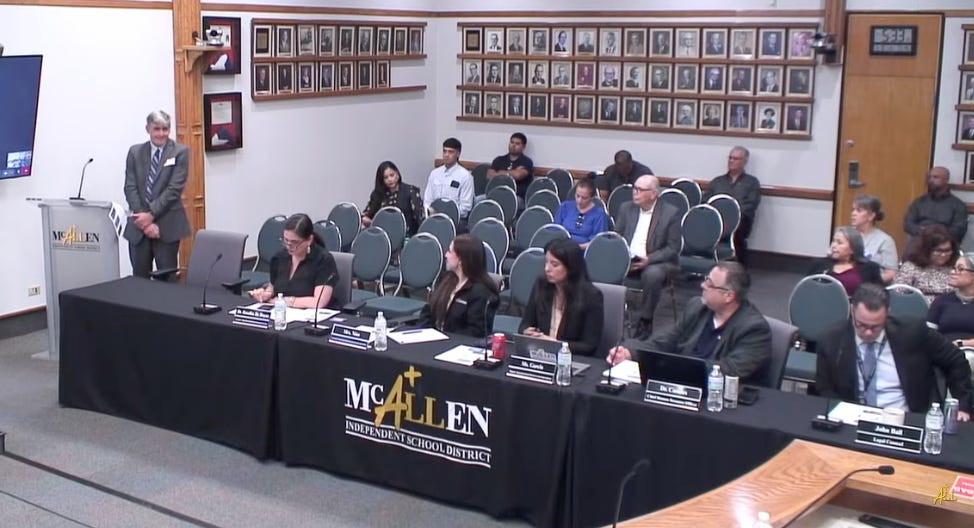
McAllen TX - The McAllen Independent School District Board of Trustees held a special workshop Thursday, June 18, 2026, to review the legal role and procurement process for a construction manager agent ahead of the district’s $335 million bond program, approved by voters May 2. No public comments were submitted during the meeting.
Superintendent Dr. René Gutiérrez introduced attorney David Hansen of Eichelbaum Wardell Hansen Powell & Munoz, who presented the legal framework governing how the district may hire and use a construction manager agent under Texas law. Gutiérrez said the workshop was scheduled after board members sought additional clarity following a prior presentation on assigning architects and engineers to bond projects.
What a Construction Manager Agent Is, and Is Not
Hansen opened by stressing the core legal limitation on the role. “A construction manager agent isn’t allowed to build anything. They’re not allowed to sign a contract or a subcontract or pick up a hammer, nothing like that. So they are an advisor, strictly an advisor,” Hansen said.
Hansen explained that under the Texas Government Code, a construction manager agent provides consultation and administrative services during the design and construction phases, helping the district manage multiple contracts with various construction prime contractors. He described the role in financial terms. “Really what we’re thinking of in a construction manager agent is more of an accountant than a builder,” Hansen said.
Hansen warned the board against conflating a project manager with a general contractor, recounting a case in which board members referred to their construction manager agent as their general contractor at trial. “They are not the builders. Even if they show up in flannel and jeans every day, they’re not the builders,” Hansen said.
Fiduciary Duty and Required Hiring Order
Hansen told the board that a construction manager agent serves the district in a fiduciary capacity, comparable to a banker, accountant, or attorney, meaning they are legally required to put the district’s interests ahead of their own.
Hansen emphasized that state law dictates a strict order of operations. The district must hire a design professional, an architect or engineer, for a specific project before that project can be assigned to a construction manager agent. “It’s not allowed in the statute that... you won’t actually be able to assign that CM agent to a project until you’ve already hired an architect for that to design that project,” Hansen said.
This point prompted extended discussion among trustees, some of whom said they had understood the construction manager agent would assist the district in selecting architects and engineers and in negotiating their fees. Hansen clarified that while some project managers in practice may take on that role for other districts, it is not authorized under the statute governing McAllen ISD’s procurement. “It’s definitely not accommodated by the statute,” Hansen said. He confirmed, however, that the district can enter into a master agreement with a construction manager agent before any architects are hired, and then assign individual projects to that agent through addendums once architects are hired for each project.
Cost Estimating and Value Engineering
Hansen said one of the construction manager agent’s most important early functions is providing more accurate, current cost estimates than architects typically provide. “A CM agent or a construction manager at risk, if you use that, they have to have a much clearer idea of what your costs are gonna be for your project,” Hansen said.
He urged the board to require independent cost estimates from both the architect and the construction manager agent at each design phase, including schematic design, design development, and construction documents, rather than allowing the figures to be combined. “Don’t let them piggyback on each other. You wanna get one independent from both, because if they’re off, you want them to reconcile,” Hansen said. He recommended the board formally approve or reject the budget and scope at the end of each phase before allowing the project to proceed. “If the board doesn’t approve the budget or the scope or whatever, then it shouldn’t go to the next step,” Hansen said.
Hansen also described value engineering as a design-phase function in which the construction manager agent identifies more cost-effective materials or systems before bidding, distinguishing it from “scope reduction,” which he said happens only after a project comes in over budget.
Responsibility for Defects
A trustee asked whether the construction manager agent bears any responsibility for ensuring a building is constructed correctly. Hansen said responsibility for construction defects rests with the contractor, and design defects rest with the architect, regardless of the construction manager agent’s role. “If you didn’t build it in accordance with the plans and specs, it doesn’t matter how much viewing the architect did of your work or how much viewing the CM agent did of your work. It doesn’t matter. You are responsible for that,” Hansen said, addressing how a contractor might respond if confronted about defective work.
Hansen distinguished between “observation,” which a construction manager agent and architect perform when reviewing pay applications, and formal “inspection,” which is a higher and more invasive standard not typically required under standard contracts. He cautioned the board against describing a construction manager agent as the district’s “eyes and ears,” warning that the phrase has been used effectively against districts in litigation. “That’s the kind of words that get used in court to forgive construction defects,” Hansen said.
Daily Logs, Scheduling, and Change Orders
Hansen said construction manager agents are typically required to maintain daily logs documenting weather conditions, personnel on site, equipment present, and work completed, which become critical evidence if a contractor later requests a schedule extension. “When your project’s late, it’s gonna show up in here,” Hansen said.
He said construction manager agents review change order requests and make recommendations but cannot themselves approve changes to design documents. “The only one that can approve a change to the design documents is who? The architect, right? Plus us,” Hansen said. “I would never delegate the authority to a construction manager agent to approve change orders. It’s your money.”
Procurement and Scoring Recommendations
Hansen confirmed that hiring a construction manager agent requires public advertisement and a two-step qualifications-based selection process under the Professional Services Procurement Act, the same framework used to hire architects. Pricing cannot be discussed until after qualifications have been ranked. “Only thing you can ask about is their qualifications,” Hansen said.
Hansen recommended the board score all procurement on a 1,000-point scale rather than the 100-point scale commonly used, both to prevent ties and to better differentiate between highly qualified and minimally qualified firms. “It’s super common to be 100,” Hansen said in response to a trustee’s comment that the district currently uses a 100-point system, before recommending the change. Superintendent Gutiérrez indicated the district would consider the change.
Hansen also recommended the board specifically ask prospective construction manager agents and contractors whether they have ever sued a school district to invalidate a contract provision, such as a liquidated damages clause, and suggested penalizing firms that answer dishonestly. “If they give a false response, you just knock 1,000 points off,” Hansen said.
A trustee asked about the propriety of interviewing top-ranked firms as part of the selection process for larger contracts. Hansen said interviews are permissible but must be disclosed in advance in the request for proposals and applied consistently across future procurements. “You just want it to be repeated. The same thing you’ve done every time,” Hansen said.
Delivery Methods Overview
Hansen closed the presentation with an overview of the five construction delivery methods available to the district under Texas law: competitive bidding, used primarily for small jobs such as parking lot regrading; competitive sealed proposals, which Hansen identified as the most commonly used method because it allows the district to negotiate scope and price after bids are received; construction manager agent; construction manager at risk, in which the firm participates in design but also serves as the actual builder under a guaranteed maximum price contract; design build, in which a single firm provides both design and construction services; and job order contracting, used for smaller recurring repair work.
Assistant Superintendent for Facilities Ruben Trevino confirmed that the district’s most recent major construction project, the UTRGV Collegiate Campus, was delivered using the design build method due to time constraints and the use of an existing prototype design.
Adjournment
The board adjourned at 7:29 p.m. on a motion by Trustee Haddad, seconded by Trustee De La Garza Lopez.
Source - McAllen ISD Board of Trustees workshop transcript