

McAllen ISD, Budget Workshop, Teacher Compensation, Pay Equity, Librarians, Employee Benefits, Athletics, McAllen TX
Arnoldo Mata
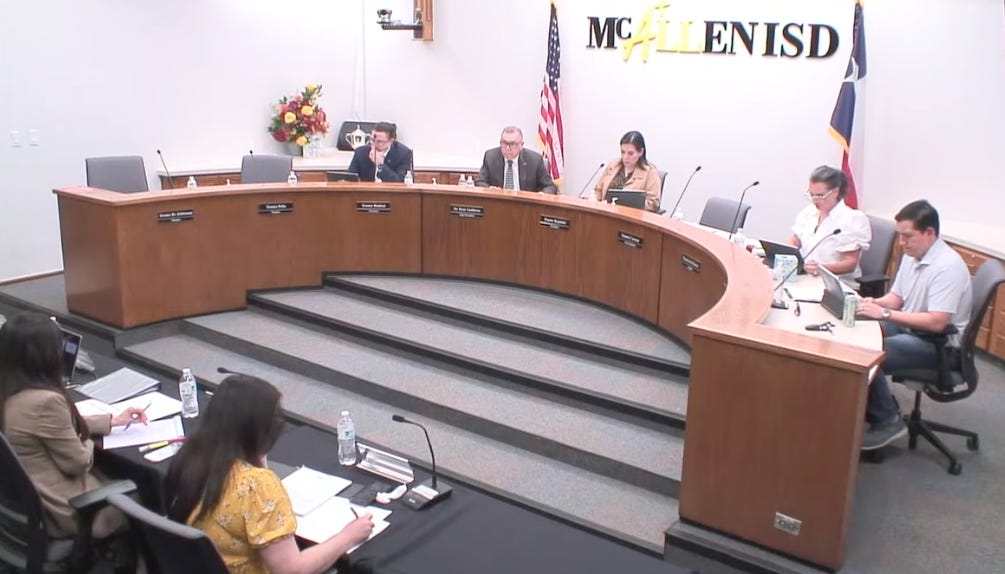
McAllen TX - The McAllen Independent School District Board of Trustees held its fifth budget workshop Wednesday evening, working through compensation scenarios, staffing proposals, employee benefits challenges, and athletics program expansions for the 2026-2027 school year with a librarian’s emotional public comment setting the tone for much of the evening’s discussion.
Deputy Superintendent for Business and Operations Lorena Garcia led the presentation, with Superintendent Dr. René Gutiérrez noting the district is in the near-final stages of the budget process. A draft budget book is expected at the next workshop, tentatively scheduled for June 17, with final board adoption set for June 23.
“We are almost in the near final stages of this budget process,” Gutiérrez said. “We are thinking that this may be the last budget workshop before we bring a draft of the final budget to the board the latter part of June.”
Librarian Pleads for Pay Equity
Before the budget presentation began, Pablo Pettis Elementary librarian Sharon DeGroot addressed the board in what she described as her first-ever public comment appearance, asking trustees to reconsider a budgetary decision that removed librarians from the teacher pay category, effectively excluding them from the teacher pay raise.
“I am heartbroken that librarians were not seen as educators in our district,” DeGroot said. “My job as a librarian is entirely instructional based.”
DeGroot walked trustees through a typical day: opening the library at 7:15 a.m. for book checkout and maker space time, teaching six back-to-back 45-minute classes, covering lunch and recess duty, then returning for additional classes before spending after-school hours on library duties such as shelving and collection development. She also sponsors a chess club with twice-weekly practices and works on lesson plans on weekends.
“That is six classes per day. I know some of my fellow librarians have more than that each day, which goes far beyond the state’s House Bill 2 requirement that teachers must teach an average of at least four hours each day,” DeGroot said.
She holds a master’s degree and said the recent classification change has deeply affected her professionally and personally. “This recent change has made me feel devalued and demoralized,” DeGroot said. “It hurts professionally and also personally to be told that I’m not seen as an educator. I am hoping you would reconsider your earlier decision to put librarians in a different pay category and be able to compensate librarians fairly.”
The librarian’s comments seemed to shape subsequent board discussion on pay equity and Teacher Incentive Allotment (TIA) eligibility throughout the workshop.
Fund Balance and Budget Overview
Garcia opened the budget presentation with a review of the district’s current fund balance position, reminding trustees the district is operating a deficit budget.
The district began the year with $152 million in total fund balance. Expenditures during the year include $3.3 million from assigned fund balance, $9 million from unassigned fund balance, $4 million from restricted fund balance, and $15 million from a restricted maintenance tax note fund that was paid off after 25 years of annual collections. Total decrease: $31.7 million.
The district projects ending the year with a total fund balance of approximately $120 million and an unassigned fund balance of approximately $96.6 million, with Garcia noting payroll savings could push that number slightly higher.
Major unassigned fund balance expenditures included stadium projects and the McAllen High field project, $1.5 million in retention stipends, Chromebook lease purchases, $823,000 for athletics transportation, fine arts program deficit carry-forward of $594,000, bond election and strategic plan costs, and UTRGV Collegiate program expenditures.
A fourth six-weeks summary of finance update showed a $3.44 million increase in tax collections offset by a $2.9 million decrease in state funding, accounting for most of the $9 million total draw from unassigned fund balance.
Budget Assumptions for 2026-2027
Key figures driving the proposed budget:
Projected enrollment: 19,203 students
Average daily attendance at 95%: 17,522
Taxable adjusted property values: increased 1.57% over last year’s certified value, a gain of $143 million
Estimated local tax revenue: $75.4 million, subject to minor compression adjustments
Projected interest earnings: $5 million
State revenue: down approximately $1 million compared to last year
Total projected payroll costs: approximately $200 million
Health plan fund contribution: $50 per employee per month under consideration
One trustee raised a concern about whether projected enrollment accounts for potential student departures due to the state’s new Educational Freedom Accounts voucher program. Garcia said the district uses the Texas Association of School Business Officials (TASBO) template for enrollment projections and acknowledged the district does not yet have a specific number for voucher impact. “We can do some research. We saw some early predictions, however they were just preliminary numbers,” she said, committing to follow up.
Compensation - Four Options
Garcia presented four compensation options for board consideration, noting the budget was balanced before any salary increases were factored in. Any raise option would push the district into a deficit.
The board was asked to select a direction by the June 2 regular meeting so staff can finalize the budget book ahead of the required June 10 newspaper notice publication.
Option A - 1% teacher pay increase, 3% hourly support staff increase, 1% administrative and professional increase. Projected deficit: $3.867 million.
Option B - 1.5% teacher pay increase, 3% hourly support staff, 1% administrative. Projected deficit: $4.2 million.
Option C - 1.75% teacher pay increase, 3% hourly support staff, 1% administrative. Projected deficit: $4.4 million.
Option D - A flat $1,000 one-time payment for all staff across the board, described as a longevity payment rather than a recurring raise. Projected cost: $4.2 million. Unlike options A through C, this would not be a recurring cost.
Garcia clarified that the percentage increases are applied to the midpoint of each employee’s pay grade, not individual salaries.
Starting teacher salary comparisons under each option:
Current base: $55,300
Option A (1%): $55,675 - a $375 increase
Option B (1.5%): $56,000 - a $700 increase
Option C (1.75%): $56,175 - an $875 increase
Trustees pressed for clarification on discrepancies between total cost figures across different slides. Dr. Canales explained that one set of figures reflected all-funds totals including market equity adjustments, stipends, and new positions, while another reflected only the core compensation and benefits gap. The all-funds totals under Option A came to $2.798 million before equity adjustments, stipends, and new positions were added.
Librarians, Pay Equity, and TIA Eligibility
Following DeGroot’s public comment, trustees pressed Garcia and Dr. Canales extensively on whether librarians could be reclassified to receive the Teacher Incentive Allotment.
Garcia explained the district is proposing market equity adjustments, recommended by the Texas Association of School Boards (TASB), for positions that moved from the teacher pay scale to other categories. These positions would be brought to at least 1% above the teacher salary at their equivalent years of experience.
“They would be making 1% over the teacher salary had they stayed in the teaching position with the same years of experience,” Garcia said.
One trustee asked directly whether this equity adjustment would address the concerns DeGroot raised. Garcia confirmed it would catch librarians up financially, though without moving them back to the teacher pay scale. The estimated cost of the equity adjustment at the 1% teacher raise level is $455,000, rising to $538,000 at 1.75%.
On TIA eligibility, Dr. Canales said librarians currently do not qualify because they are not coded as teachers, do not carry a formal student roster tied to a tested course, and cannot demonstrate student growth as measured under TIA guidelines. “They have to be coded 087 and librarians are not coded 087,” Canales said. “They have to teach at least four hours a day, but they also have to have a roster. That was a difference on the TIA part of it.”
Canales noted that TEA went back and forth on including librarians and counselors under the retention allotment last year before ultimately removing them at the end of the process.
One trustee asked whether any other districts are coding librarians as teachers to qualify for TIA. Canales said he is not aware of any that have done so for TIA purposes, though some may have dual-role librarians who teach content courses part of the day. The board directed staff to research the issue further with TEA. “We’ll check with TEA. We can start off with TEA and check it,” Gutiérrez said.
The board also confirmed that the equity adjustments would apply to counselors and other positions listed on the TASB equity chart, not just librarians.
New Positions Proposed for 2026-2027
Dr. Canales presented a list of proposed new positions for the coming school year:
TIA Coordinator - to be funded through TIA allotment money
CTE Teacher - adding a barber program teacher
CTE Clerk - funded through the district’s 173 budget
Clerk for Medicaid - funded under the 173 budget
Counselor for MILM - district-wide position housed at MILM to serve growing special education numbers
Physical Therapist - the district currently serves 103 students requiring physical therapy services
Middle School Mariachi Teacher - to support the growing mariachi program
Bond Project Manager - Gutiérrez noted this position would be covered in more depth at Tuesday’s meeting during the bond update
School Safety Specialist - the district is proposing renaming and restructuring the emergency management position, with the police chief taking on the stipend and an additional specialist being added to broaden the search pool
Supplemental Compensation and Stipend Proposals
The following stipend adjustments were presented:
Child Nutrition, Certified Forklift Operator Trainer: New stipend of $500
Dyslexia: One additional position added at the existing $3,000 annual stipend
Special Education: Positions increasing from 45 to 53; special education teachers from 108 to 122, with existing stipend amounts unchanged
Chain Crew (Athletics): Increasing from $35 flat fee to $45, a $10 increase; total cost $600
Cheerleading Head Sponsor: Increasing from $7,500 to $8,700 to reflect year-round sport designation
Cheer Assistant: Increasing to $5,500 to match year-round sport stipends
Dance Team Sponsor: Increasing to $8,700 to match cheerleading
Dance Team Assistant: Increasing to $5,500 to match athletics
UIL Robotics (high school): Increasing $100 to $1,300 to align with other stipends
Yearbook (high school): Increasing from $1,500 to $2,000
Yearbook (middle school): Increasing from $500 to $1,000
State and Federal Programs: New stipend of $500 each for 13 positions, replacing mileage payments for employees who travel between campuses
Title II Grant-Funded Stipends: Staff recommended discontinuing these for the 2027-2028 school year, giving employees advance notice now
The board discussed at length whether proposed stipend increases would allow campuses with multiple cheer teams (varsity, JV, and freshman) to hire the coaches they need. Dr. Canales and Athletics Director Brian McClenny proposed a flexible stipend model for wrestling, powerlifting, and cheer, where budget amounts are allocated but only drawn when needed based on participation numbers reviewed annually.
For the 2026-2027 school year specifically, the flexible stipend would apply to Memorial Wrestling (81 wrestlers), powerlifting at McAllen High (96 athletes) and Memorial (87 athletes), and an additional cheer stipend for Nikki Rowe, which has 61 cheerleaders. Rowe’s additional stipend would be reviewed each year based on squad size.
Athletics Staffing and Coach Ratios
The board reviewed a comparison of assistant football coach ratios among area districts, finding McAllen currently at 14 assistant coaches, among the lowest in the region. With the addition of one football assistant and one tennis assistant being proposed, McAllen would move to 15 assistant coaches for football.
Surrounding districts by comparison: Pharr-San Juan-Alamo, 16; Donna, 16; Weslaco, 21; Mission, 17; Sharyland, 15; Los Fresnos, 19; San Benito, 22; Brownsville, 16; Harlingen, 15; Edinburg, 17.
The board noted that some districts also offer additional stipends for video and tech equipment coordination, scouting, and UIL coordinators that McAllen does not currently provide.
Pay Grade Reclassifications
Following TASB recommendations, the district is proposing to move several positions to higher pay grades to improve recruitment and retention:
Buyer, Specialist Accounting, Specialist Budget and Cost, Specialist Student Outreach: moving from pay grade 1 to pay grade 2
Attendance Clerk: moving from pay grade 1 to pay grade 2
Head Attendance Officer: moving from pay grade 2 to pay grade 3
Instructional Assistant Parent Involvement: moving from pay grade 1 to pay grade 2
Instructional Assistant Technology Support: moving from pay grade 2 to pay grade 3
Custodian: moving from pay grade 1 to pay grade 2
Custodian Itinerant: moving from pay grade 1 to pay grade 2
Lead Custodian (High School): moving from pay grade 2 to pay grade 3
“A lot of these positions are competing with schools but also with the public sector,” Dr. Canales said. “We want to see that by moving them to the next higher pay grade we can hire them and retain them.”
Employee Benefits and Health Fund Update
The district’s health fund presentation revealed a projected shortfall of $1.24 million for the current fiscal year, driven by high-cost claims and improper billing by an out-of-network emergency room provider.
Claims activity from January through April included 12 high-cost claims: six between $50,000 and $100,000, four between $100,000 and $200,000, and two between $200,000 and $600,000, totaling $1.6 million in high-cost claims alone. Additional factors include $1.8 million in runoff claims and $514,000 in emergency room claims tied to improper billing practices.
The benefits administrator explained that an out-of-network emergency room facility had been advertising to employees as if it were a regular in-network clinic, resulting in employees using the provider without paying their share while the full cost hit the district’s plan. “Some advertisement was falsely said. Unfortunately, people took them up to their word,” the presenter said.
The district has notified all staff, informed principals, and is working with UnitedHealthcare’s investigative unit to audit and recover funds. “Their investigative unit is aware. We have weekly discussions with UHC in regards to this facility and we’re hoping we’ll receive those funds back to the plan,” the presenter said.
To address the shortfall, the district is recommending using $1 million from workers’ compensation funds and additional unemployment funds, each carrying balances in excess of their reserve requirements.
On a more positive note, the presenter reported that claims spending from January through April this year totaled $4.9 million, compared to $7.7 million over the same period last year, a significant improvement.
Looking ahead, the district plans to bring a formal budget amendment to address the projected shortfall and will hold a deep-dive utilization review with UnitedHealthcare and Aria in October.
The board discussed whether to include the $50 per employee per month health fund contribution in the budget or set aside $2 million in assigned fund balance instead. Board President Gutiérrez leaned toward the set-aside approach. “Perhaps we may not need it, but maybe set aside those $2 million and not take the $50 per employee because then that would be a direct reduction of our funds,” Gutiérrez said. “Rather than just put those $2 million aside in case we need them, I think we can go in that direction.”
Garcia confirmed the set-aside option would also allow the district to earn interest on the funds while they remain in the balance.
Next Steps
The board was asked to provide direction on two key items by the June 2 regular meeting:
Which compensation option, A, B, C, or D, to use for building the budget book
Whether to include the $50 per employee per month health contribution or set aside $2 million in assigned fund balance
Additional budget milestones:
June 2: Regular board meeting, board to provide compensation model direction
June 10: Required newspaper notice of budget must be posted
June 17: Sixth budget workshop, draft budget and draft budget book presented to board
June 23: Final budget adoption